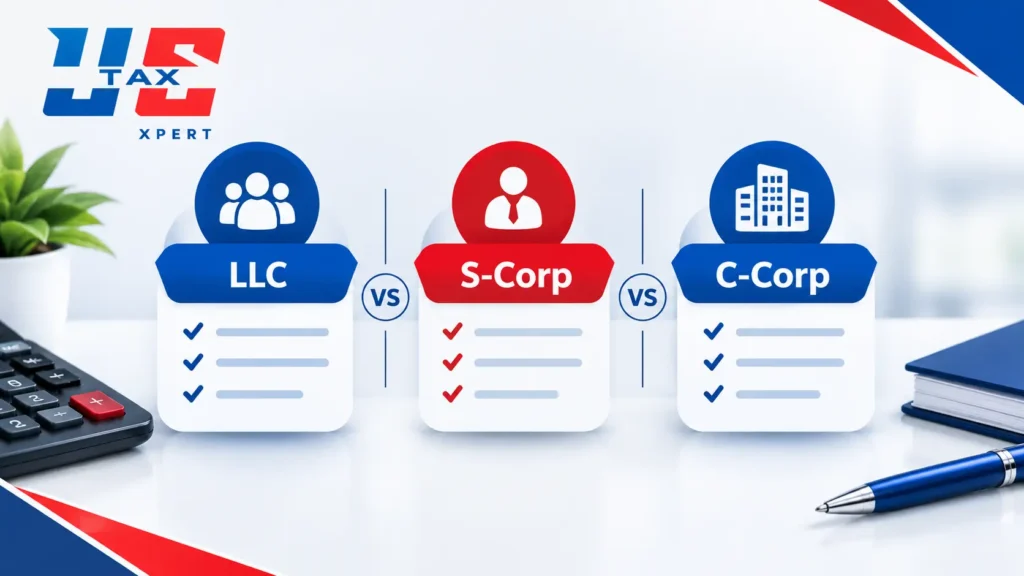
One of the first major decisions a new business owner faces is choosing the right legal and tax structure. The LLC vs S-Corp vs C-Corp decision affects everything from how much tax you pay to how much paperwork you’ll deal with every year — and switching later isn’t always simple.
This guide breaks down how each structure works, who typically benefits from each, and what to consider before filing your formation paperwork.
Quick Comparison: LLC vs. S-Corp vs. C-Corp
| Factor | LLC (default) | S-Corp Election | C-Corp |
|---|---|---|---|
| Taxation | Pass-through — profit taxed on owner’s personal return | Pass-through, but only salary is subject to self-employment tax | Taxed at the corporate level, then again on dividends (double taxation) |
| Self-employment tax | Applies to all profit | Applies only to salary, not distributions | Not applicable in the same way — owners are employees |
| Ownership restrictions | Flexible, few restrictions | Max 100 shareholders, one class of stock, U.S. citizens/residents only | No restrictions on number or type of shareholders |
| Ability to raise outside investment | Limited appeal to investors | Limited appeal to investors | Preferred structure for venture capital and institutional investment |
| Administrative complexity | Lowest | Moderate — requires payroll | Highest — formal board, minutes, more extensive filings |
LLC: The Default Structure for Most Small Businesses
A Limited Liability Company (LLC) offers liability protection while keeping taxation simple. By default, an LLC is taxed as a pass-through entity — profit flows directly to the owner’s personal tax return, and there’s no separate corporate-level tax.
Best suited for: Freelancers, small business owners, and early-stage companies that want liability protection without complex corporate formalities.
S-Corp Election: A Tax Status, Not a Separate Entity
It’s a common misconception that S-Corp is a business structure you form directly. In reality, an LLC or a corporation elects S-Corp tax treatment with the IRS — it changes how the entity is taxed, not its underlying legal structure.
Under S-Corp election, the owner becomes a W-2 employee of the business, paying self-employment tax only on their salary rather than on all business profit. Remaining profit can be distributed without additional self-employment tax.
Best suited for: Profitable, established small businesses where the tax savings from S-Corp election outweigh the added cost of running payroll. Learn more in our detailed guide to S-Corp election for LLCs.
C-Corp: Built for Growth and Outside Investment
A C-Corp is a fully separate legal and tax entity from its owners. It pays corporate income tax on its profits, and if those profits are distributed to shareholders as dividends, the shareholders pay tax on that income again — this is what’s known as “double taxation.”
Despite this, C-Corps remain the preferred structure for businesses planning to raise venture capital or eventually go public, since they allow unlimited shareholders, multiple classes of stock, and international ownership.
Best suited for: Startups planning to raise significant outside investment, businesses planning an eventual IPO, or companies that want to retain earnings within the business rather than distributing them immediately.
Key Factors to Consider When Choosing
How Much Profit Does the Business Generate?
Lower-profit businesses often don’t benefit enough from S-Corp election to justify the added payroll complexity. Higher-profit businesses may see meaningful self-employment tax savings.
Do You Plan to Raise Outside Investment?
If venture capital or institutional investment is part of your plan, a C-Corp is typically the expected and preferred structure, since most investors are structured to invest in C-Corps specifically.
How Much Administrative Complexity Can You Manage?
LLCs require the least ongoing formality. S-Corps require payroll. C-Corps require formal governance, including a board of directors, regular meetings, and more extensive recordkeeping.
Do You Want to Retain Profit in the Business?
C-Corps can retain earnings within the business without those earnings being immediately taxed to the owners, which can be useful for businesses reinvesting heavily in growth.
Can You Change Your Business Structure Later?
Yes, though it’s not always simple. Common transitions include:
- An LLC electing S-Corp tax treatment once it becomes profitable enough
- A growing business converting from an LLC to a C-Corp before raising venture capital
- Reversing an S-Corp election back to default LLC taxation if circumstances change
Each transition carries its own tax and administrative implications, so it’s worth planning ahead rather than restructuring reactively.
Common Mistakes When Choosing a Business Structure
- Forming a C-Corp too early without a clear need for outside investment, taking on unnecessary complexity and double taxation
- Electing S-Corp status before the business is profitable enough to justify it
- Choosing a structure based solely on liability protection without considering the tax implications
- Not revisiting the decision as the business grows and circumstances change
Getting Formation and Tax Structure Right From the Start
The right structure depends on your specific business goals, expected profit, and growth plans — there’s no universal right answer. If you’re forming a new business, our business formation and EIN registration services can help you get the paperwork right, and business consulting support can help you model the tax impact of each structure before you decide.
Frequently Asked Questions
Is an S-Corp a type of business entity like an LLC or C-Corp?
No. S-Corp is a tax election made by an LLC or corporation, not a separate legal business structure of its own.
Which structure is best for a small business just starting out?
Most new small businesses start as an LLC due to its simplicity and flexibility, potentially electing S-Corp tax treatment later once profitable enough to benefit from it.
Why do C-Corps face double taxation?
Because the corporation itself pays tax on its profits, and shareholders pay tax again on any dividends distributed from those already-taxed profits.
Can a single-person business be a C-Corp?
Yes, though it’s uncommon for very small or solo businesses given the added complexity and double taxation, unless there’s a specific reason like planned investment or IPO plans.
Do I need a lawyer to choose between these structures?
While not strictly required, working with both a tax professional and an attorney is recommended, since the decision has both tax and legal implications specific to your situation.
Can I switch from an LLC to a C-Corp later if I need to raise investment?
Yes, this is a common path for startups — many begin as an LLC and convert to a C-Corp when they’re ready to raise venture capital, since most investors require that structure.
Choose the Right Structure for Your Business
The entity you choose today affects your taxes for years to come. Schedule a consultation to determine which structure actually fits your business goals.