

If your LLC is generating steady profit, you’ve probably heard other business owners mention the S-Corp election as a way to save on taxes. It’s one of the most common tax-planning questions small business owners ask — and one of the most commonly misunderstood.
Electing S-Corp status doesn’t change your legal business structure. Your LLC stays an LLC. What changes is how the IRS taxes your profit — and for the right business, that can mean real self-employment tax savings.
This guide walks through how the S-Corp election actually works, who benefits from it, and what you need to weigh before filing.
What Does S-Corp Election Actually Mean?
By default, a single-member LLC is taxed as a sole proprietorship, and a multi-member LLC is taxed as a partnership. In both cases, all business profit is subject to self-employment tax — currently 15.3% — on top of regular income tax.
When you elect S-Corp tax treatment, you become a W-2 employee of your own business. You pay yourself a “reasonable salary” through payroll, and only that salary is subject to self-employment (payroll) tax. Any remaining profit can be distributed to you separately, without self-employment tax applied to it.
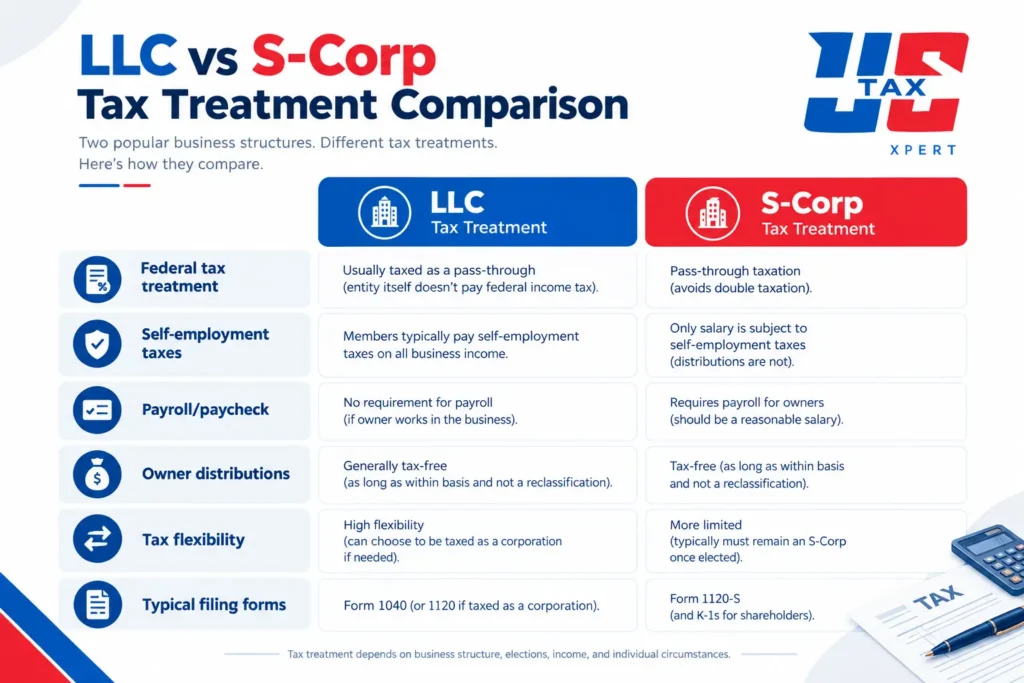
LLC vs. S-Corp: How the Tax Treatment Compares
| Factor | Default LLC Taxation | LLC With S-Corp Election |
|---|---|---|
| Self-employment tax | Applies to all business profit | Applies only to your salary, not distributions |
| Payroll requirement | None | Required — you must run payroll for yourself |
| Administrative cost | Lower | Higher (payroll processing, additional tax filings) |
| Best suited for | Lower-profit businesses, early-stage startups | Profitable businesses with consistent net income |
Who Actually Benefits from S-Corp Election?
S-Corp election isn’t automatically a good idea for every LLC. It tends to make financial sense when:
- Your business consistently nets a meaningful profit — often cited around $40,000–$60,000 or more after expenses
- You can pay yourself a genuinely reasonable salary and still have profit left to distribute
- You’re prepared to handle the added administrative work of running payroll
If your LLC’s profit is small or inconsistent, the extra cost of payroll processing and additional tax filings can outweigh the self-employment tax savings.
The “Reasonable Salary” Requirement
This is the part of the S-Corp election the IRS scrutinizes most closely. You can’t pay yourself a token salary and take the rest as distributions purely to avoid self-employment tax. The IRS expects your salary to reflect what someone would reasonably be paid for the work you do in your role and industry.
Common factors used to determine a reasonable salary include:
- Industry salary benchmarks for similar roles
- Your time commitment to the business
- Your business’s overall revenue and profit
- Comparable compensation for employees performing similar functions
Underpaying yourself to minimize payroll tax is one of the most common triggers for IRS scrutiny of S-Corp elections.
How to Make the S-Corp Election
Step 1: Confirm Your LLC Is Eligible
Your LLC must meet basic S-Corp eligibility requirements, including having no more than 100 owners and only one class of stock/membership interest.
Step 2: File Form 2553 With the IRS
This is the formal election form. Timing matters — generally, it must be filed within two months and 15 days of the start of the tax year you want the election to apply to, though late election relief is sometimes available.
Step 3: Set Up Payroll
Once elected, you’re required to run payroll for yourself as an employee, including withholding and remitting payroll taxes on a regular schedule.
Step 4: Maintain Separate Records for Salary and Distributions
Your bookkeeping needs to clearly distinguish between your W-2 salary and any additional profit distributions, since they’re taxed differently.
Common Mistakes Business Owners Make With S-Corp Election
- Electing S-Corp status before the business is profitable enough to justify the added cost
- Paying an unreasonably low salary relative to distributions
- Failing to actually run payroll after making the election
- Missing the election deadline and having to wait until the following tax year
- Not accounting for the added cost of payroll services when weighing the decision
Is S-Corp Election Right for You? A Quick Gut Check
Ask yourself these questions before deciding:
- Is my LLC’s annual net profit consistently high enough to make the tax savings worth the added administrative cost?
- Am I willing and able to run payroll, even if it’s just for myself?
- Do I have a bookkeeping system in place that can separate salary from distributions?
If you answered yes to all three, it’s worth running the numbers with a tax professional. If you’re unsure, business consulting support can help you model out the actual dollar impact before you file anything.
Frequently Asked Questions
Does the S-Corp election change my LLC’s legal structure? No. Your LLC remains an LLC for legal purposes. The S-Corp election only changes how the IRS taxes your business income.
How much can I actually save with the S-Corp election? It depends entirely on your profit level and what salary is considered “reasonable” for your role. Savings typically come from reducing the amount of profit subject to the 15.3% self-employment tax.
What happens if I pay myself too low a salary? The IRS can reclassify distributions as wages, which can result in back payroll taxes, penalties, and interest.
Can a single-member LLC elect S-Corp status? Yes. Single-member LLCs can elect S-Corp tax treatment, though it’s especially important to weigh the added payroll and administrative costs against the potential savings.
When is the deadline to file Form 2553? Generally within two months and 15 days after the start of the tax year the election should apply to, though the IRS does allow late election relief in certain circumstances.
Do I need to hire a payroll service after electing S-Corp status? Not strictly required, but strongly recommended — running compliant payroll (including tax withholding and filings) is complex enough that most business owners benefit from professional support. See our accounting and payroll services for details.
Considering S-Corp Election for Your LLC?
The right choice depends entirely on your specific numbers — there’s no one-size-fits-all answer. Schedule a consultation with our team to find out whether the S-Corp election actually makes sense for your business.